
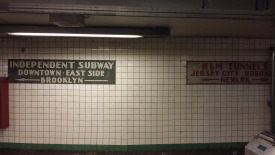
From the Independent Subway to the Freedom Tower, Americans rightly love their independence and freedom. But our affinity for liberty can be bad for urban planning, because it can hinder collaboration, coordination, and compromise. State’s rights and municipal police powers combine to make regional planning particular difficult in the United States. In the New York region, three states (governed […]
Tag Archives: Cities

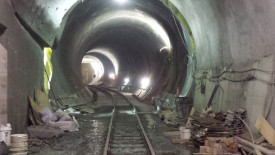






Keep New York On Track, Off the Tracks
. New York City’s subway network was designed for speed. It was purposefully built near the surface, along major transportation corridors, not only in order to lower costs, but in order to ease congestion on the street, and allow for quick access to stations. Unlike newer sections of the subway, dug deep underground in order […]
Bridge the Gap
. New York City, arguably the world’s premier global city, is the largest in the richest country in the world. The metropolitan region hosts 23+ million people, more than the population of Australia, and New York’s population continues to rise. The MTA network spans 5,000 miles, with more than 2,000 miles of track—enough to stretch from New […]
A Riel (Estate) Plan for NYC
Riel, 2015 Born and bred in Brooklyn, I firmly believe that the New York region remains the cultural capital of the world. With more people in the metropolitan area than in the entire continent of Australia, New York continues to harbor diverse and creative opportunities due to its inherent dynamism and density, catalyzed by the […]
International Urban Development and Transportation
T.O.D. should not only be about transit-oriented development, but about transit-owned development. When I was a child, I was the first in my classroom to notice that the World Trade Center (Tower 1) had been struck, and I later helped to close our windows, watching as it collapsed. The World Trade Center was a transit-owned, transit-oriented development, […]
Thinking Beyond Buildings
. Public transportation authorities often do not control zoning and land use laws, and they also operate amidst a sea of privately-owned land. In fact, America’s land use laws are arguably reflected by its LEED incentives. The LEED Neighborhood Development Rating System rightly incentivizes LEED construction in transit-oriented communities by prioritizing an access to quality transit, […]
Reforming the MTA
Please feel free to view my Capstone: Bridging the Transportation Finance Gap: Planning Beyond Boundaries for a Connected 21st Century Please also feel free to view my Senior Honors Thesis: (Re)New Your City, New York City: Transporting Transformation Hubs New York’s Metropolitan Transportation Authority (MTA) is constantly running trains, but it is also constantly running […]
TOD: Transit-Owned Development
Summary: New York’s Metropolitan Transportation Authority (MTA) is constantly running trains, but it is also constantly running a deficit. Unlike profitable transportation companies, such as the Hong Kong Mass Transit Railway (MTR), the MTA has few valuable real estate assets which could be adequately transformed into transit-oriented and transit-owned joint development hubs. Similar to other […]
(RE)New York City
Riel, 2014 . (Re)New Your City, New York City: Transporting Transformation Hubs America’s public transportation agencies cannot be profitable in the 21st century due to a political economy that isolates these agencies from municipal zoning and land use policies, and from forming value capture mechanisms – from tax increment financing to joint development and the […]
Extensions & Expansions
As local lore has it, when a relative asked Charles Tufts what he would do with his land, and more specifically with “that bleak hill over in Medford,” Tufts replied, “I will put a light on it.” The Universalist Church founded Tufts University in the 1840s with a gift of 20 acres of land from Boston […]