As technology continues to improve and performance standards are met or bettered, it seems increasingly less relevant to plan for specific industrial uses. In this rapdly changing market economy, how are we able to correcly project where an industrial business should be located? Perhaps instead of uses, we could organize industries based on their need for proximty and transportation speeds? Like planning for Accessibility Zones?
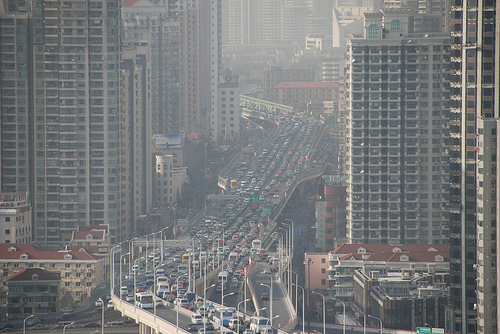
This is not an image of speed in China. Photo from Bert van Dijk’s flickr stream
One of the articles in the latest Journal of the American Planning Association (JAPA) got me thinking about this, and how the density of interactions is related to the urban form. The study, Does Accessibility Require Density or Speed: A Comparison of Fast Versus Close in Getting Where You Want to Go in U.S. Metropolitan Regions (Spring 2012 v78, n2), looked at the definition of transportation accessibility through speed and density metrics (the article can be found at various libraries or dowloaded here).
The study’s goal was to be able to compare accessibility measures across multiple metropolitan areas. Their methodology utilized the gravity model which accounts for both the transportation network and the surrounding land use conditions. Study areas are then ranked based on an accessibility index: the greater the score, the greater the advantage a person has in reaching a destination. A high score on the index is a result of a person either having many destinations nearby, or being capable of reaching distant destinations quickly, or a combination of both measures of proximity and speed. The resulting study not only developed an accessibility index, but also measured the advantages certain cities have over one another in terms of speed or proximity.
So this got me thinking: couldn’t this also be done with industry/economic sectors? Would it be possible to determine a sector’s speed and proximity needs, and then compare them to a city’s accessibility index? Perhaps it could help explain one of the reasons certain sectors locate in certain cities, or even in certain neighborhoods within cities, and why certain cities and regions have industry advantages. Perhaps this could help determine the best geographical locations for sectors or, where there are already clusters, what accessibility improvements would be needed to help them thrive.
Do you know of any studies similar to this? If not, are you interested in working on something like this?


